New


Toasts & Alerts
Loading the page…
Loading the page…
Before you buy
How this mobile component gets from the preview into your project, and what buyers ask most.
How to use it
From the preview to your project
Try it in the preview
Switch between light and dark, and resize it to phone and tablet widths, before you decide.
Get it
Free products are yours with a free account. Paid ones settle in USDT on TRON, sent straight to the wallet on your order.
Install it
Components go into your project with one shadcn command, dependencies included. Everything else downloads with a checksum.
Make it yours
It's your code now: rename it, restyle it and wire in your real data.
Or hand it to your AI
Copy the prompt and let your coding assistant place it in your project, following your conventions.
Yes, a free one: it keeps your order, every payment you make for it and the files together. Free products need it too: without an account you can look and try the live preview, but not download, install or copy anything.
Send the price as a USDT transfer on TRON (TRC-20) to the wallet on your order, shown with its QR code, then paste the transaction ID on the order. It's checked on-chain, and the files unlock once it's confirmed. Paid less? You're asked for the rest.
Yes. The Standard License covers unlimited personal and commercial projects, client work included; just don't resell it on its own. Open-source licenses say so on the product.
Create a CLI token on your account page, put it in your project's .env.local, add UpFork to components.json once, and install with npx shadcn add: free and paid components alike.
Onto your order, in your account. Download links last ten minutes and can be made again.
Releases are scanned for malware and reviewed before anyone can download them, and every file shows its SHA-256 so you can check what you got.
Building with an AI assistant?
Copy a ready-made prompt with the code, its dependencies and a demo, and your assistant can put it in place for you.
Selling your own work?
Get approved once, then publish components, templates and mobile components, paid in USDT straight to your own wallet.
Mobile
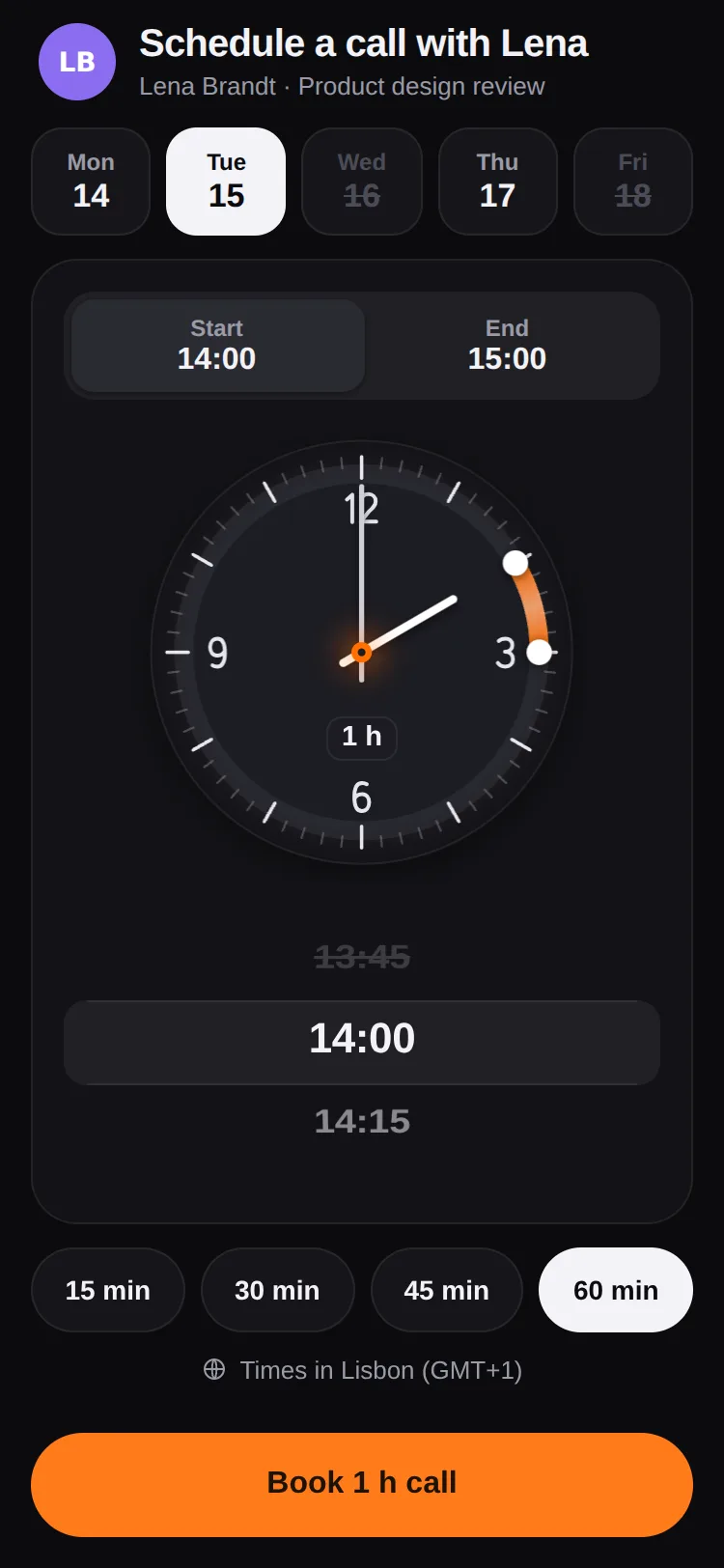
A time picker where a wheel of times and a live analog clock move as one: wind the wheel and the hands sweep. Single times or ranges with the booked arc on the face, unavailable slots skipped, a minute hand you can drag, a sun and moon by day and night. Skia, touch and mouse…
by UpFork, built by Ramin ValadanMobile componentUpdated 14 Oct 2026
Tags
6 files · 5 packages
import {
  BlurMask,
  Canvas,
  Circle,
  Group,
  LinearGradient,
  Paint,
  Path,
  Picture,
  RadialGradient,
  Rect,
  Shadow,
  Skia,
  SweepGradient,
  createPicture,
  vec,
  type SkPath,
} from '@shopify/react-native-skia';
import { useMemo } from 'react';
import { StyleSheet, View, type StyleProp, type ViewStyle } from 'react-native';
import { interpolateColor, useDerivedValue, type SharedValue } from 'react-native-reanimated';

import { useScheme, type Scheme } from '../../lib/use-scheme';

export type AnalogClockProps = {
  /** Minutes since 00:00, fractional and unbounded: the hands follow it (past midnight, they keep going forwards). */
  minutes: SharedValue<number>;
  size?: number;
  /** A booked span drawn round the face, from `start` to `end` (minutes; `end` after `start`). */
  range?: { start: SharedValue<number>; end: SharedValue<number> } | null;
  showNumerals?: 'none' | 'quarters' | 'all';
  /** The face warms by day and deepens by night, with a sun or a moon in a window at six. */
  dayNight?: boolean;
  accent?: string;
  /** Hands jump to whole steps of this many minutes instead of sweeping (reduced motion). */
  snapTo?: number;
  scheme?: Scheme;
  style?: StyleProp<ViewStyle>;
};

const LOOK = {
  light: {
    face: '#F6F5F2',
    faceDay: '#FBF3E6',
    faceNight: '#E6E8F1',
    rim: 'rgba(20, 20, 30, 0.07)',
    edge: 'rgba(20, 20, 30, 0.07)',
    tick5: '#2A2A33',
    tick1: '#B9B8C0',
    numeral: '#2A2A33',
    hour: '#15151C',
    minute: '#3A3A46',
    shadow: 'rgba(20, 20, 30, 0.28)',
    track: 'rgba(20, 20, 30, 0.05)',
    handle: '#FFFFFF',
    glow: 0,
  },
  dark: {
    face: '#1C1C22',
    faceDay: '#24211C',
    faceNight: '#191B26',
    rim: 'rgba(255, 255, 255, 0.07)',
    edge: 'rgba(0, 0, 0, 0.35)',
    tick5: '#E6E6EC',
    tick1: '#4A4A55',
    numeral: '#E6E6EC',
    hour: '#FFFFFF',
    minute: '#CFCFD8',
    shadow: 'rgba(0, 0, 0, 0.55)',
    track: 'rgba(255, 255, 255, 0.06)',
    handle: '#FFFFFF',
    glow: 1,
  },
} as const;

// Numerals drawn as single strokes in a 6 × 10 box: no font needed (Skia on the web has none).
const DIGITS: Record<string, { d: string; w: number }> = {
  '0': { d: 'M3 0.4C4.6 0.4 5.6 2 5.6 5.1C5.6 8.2 4.6 9.8 3 9.8C1.4 9.8 0.4 8.2 0.4 5.1C0.4 2 1.4 0.4 3 0.4Z', w: 6 },
  '1': { d: 'M0.4 2.2L2.2 0.6V9.8', w: 3.4 },
  '2': { d: 'M0.6 2.6C0.9 1.2 1.9 0.4 3.1 0.4C4.6 0.4 5.6 1.4 5.6 2.8C5.6 4.2 4.6 5.1 3.3 6.2L0.6 9.6H5.8', w: 6.2 },
  '3': { d: 'M0.8 1.2C1.4 0.6 2.2 0.4 3 0.4C4.5 0.4 5.4 1.3 5.4 2.6C5.4 3.9 4.4 4.8 2.9 4.8C4.6 4.8 5.6 5.8 5.6 7.3C5.6 8.8 4.5 9.8 3 9.8C1.9 9.8 1 9.3 0.5 8.6', w: 6.1 },
  '4': { d: 'M4.4 9.8V0.4L0.4 6.8H5.8', w: 6.2 },
  '5': { d: 'M5.2 0.6H1.2L0.8 4.6C1.4 4.1 2.2 3.9 3 3.9C4.6 3.9 5.6 5 5.6 6.8C5.6 8.6 4.5 9.8 2.9 9.8C1.8 9.8 1 9.3 0.5 8.6', w: 6.1 },
  '6': { d: 'M4.8 0.8C4.3 0.5 3.7 0.4 3.2 0.4C1.6 0.4 0.6 2 0.6 5C0.6 8.2 1.6 9.8 3.1 9.8C4.6 9.8 5.6 8.6 5.6 6.9C5.6 5.2 4.6 4.1 3.2 4.1C2 4.1 1 4.8 0.6 5.8', w: 6.1 },
  '7': { d: 'M0.4 0.6H5.6L2.2 9.8', w: 6 },
  '8': { d: 'M3 4.8C1.7 4.8 0.8 4 0.8 2.6C0.8 1.3 1.7 0.4 3 0.4C4.3 0.4 5.2 1.3 5.2 2.6C5.2 4 4.3 4.8 3 4.8ZM3 4.8C4.5 4.8 5.6 5.8 5.6 7.3C5.6 8.8 4.5 9.8 3 9.8C1.5 9.8 0.4 8.8 0.4 7.3C0.4 5.8 1.5 4.8 3 4.8Z', w: 6 },
  '9': { d: 'M1.2 9.4C1.7 9.7 2.3 9.8 2.8 9.8C4.4 9.8 5.4 8.2 5.4 5.2C5.4 2 4.4 0.4 2.9 0.4C1.4 0.4 0.4 1.6 0.4 3.3C0.4 5 1.4 6.1 2.8 6.1C4 6.1 5 5.4 5.4 4.4', w: 6 },
};

/** A numeral as one path, centred on (cx, cy), `height` tall. */
function numeral(text: string, cx: number, cy: number, height: number): SkPath {
  const scale = height / 10;
  const gap = 1.1;
  const width = [...text].reduce((sum, ch) => sum + DIGITS[ch].w, 0) + gap * (text.length - 1);
  let x = cx - (width * scale) / 2;
  const out = Skia.Path.Make();
  for (const ch of text) {
    const glyph = Skia.Path.MakeFromSVGString(DIGITS[ch].d);
    if (glyph) {
      const m = Skia.Matrix();
      m.translate(x, cy - height / 2);
      m.scale(scale, scale);
      glyph.transform(m);
      out.addPath(glyph);
    }
    x += (DIGITS[ch].w + gap) * scale;
  }
  return out;
}

/** A crescent moon, centred on the origin. */
function crescent(r: number): SkPath {
  const full = Skia.Path.Make();
  full.addCircle(0, 0, r);
  const bite = Skia.Path.Make();
  bite.addCircle(r * 0.5, -r * 0.3, r * 0.86);
  return Skia.Path.MakeFromOp(full, bite, 1 /* difference */) ?? full;
}

function smoothstep(a: number, b: number, x: number) {
  'worklet';
  const t = Math.max(0, Math.min(1, (x - a) / (b - a)));
  return t * t * (3 - 2 * t);
}

/** How much of the day it is, 0 (night) to 1 (day), with soft dawns and dusks. */
function daylight(minutes: number) {
  'worklet';
  const t = ((minutes % 1440) + 1440) % 1440;
  return smoothstep(300, 420, t) - smoothstep(1020, 1170, t);
}

/**
 * An analog clock drawn with Skia. Its face (ticks, numerals) is drawn once into a picture; each frame only the
 * hands, the range and the day/night tint change.
 */
export function AnalogClock({
  minutes,
  size = 220,
  range = null,
  showNumerals = 'quarters',
  dayNight = false,
  accent = '#FF7A1A',
  snapTo = 0,
  scheme: schemeProp,
  style,
}: AnalogClockProps) {
  const scheme = useScheme(schemeProp);
  const look = LOOK[scheme];
  const pad = Math.max(6, size * 0.04);
  const box = size + pad * 2;
  const c = box / 2;
  const R = size / 2;

  // The face's fixed parts: drawn once.
  const face = useMemo(() => {
    const rect = Skia.XYWHRect(0, 0, box, box);
    return createPicture((canvas) => {
      const paint = Skia.Paint();
      paint.setAntiAlias(true);
      paint.setStyle(1);
      paint.setStrokeCap(1);
      for (let i = 0; i < 60; i += 1) {
        const five = i % 5 === 0;
        const a = (i / 60) * Math.PI * 2;
        const outer = R * 0.92;
        const inner = outer - R * (five ? 0.1 : 0.05);
        paint.setColor(Skia.Color(five ? look.tick5 : look.tick1));
        paint.setStrokeWidth(five ? Math.max(1.4, size * 0.008) : Math.max(1, size * 0.005));
        canvas.drawLine(c + Math.sin(a) * inner, c - Math.cos(a) * inner, c + Math.sin(a) * outer, c - Math.cos(a) * outer, paint);
      }
      if (showNumerals !== 'none') {
        const height = Math.max(7, R * 0.14);
        const ring = R * 0.68;
        const hours = showNumerals === 'all' ? [12, 1, 2, 3, 4, 5, 6, 7, 8, 9, 10, 11] : [12, 3, 6, 9];
        const numerals = Skia.Path.Make();
        for (const h of hours) {
          if (dayNight && h === 6) continue; // the window sits at six
          const a = ((h % 12) / 12) * Math.PI * 2;
          numerals.addPath(numeral(String(h), c + Math.sin(a) * ring, c - Math.cos(a) * ring, height));
        }
        const ink = Skia.Paint();
        ink.setAntiAlias(true);
        ink.setStyle(1);
        ink.setStrokeCap(1);
        ink.setStrokeJoin(1);
        ink.setStrokeWidth(Math.max(1.1, height * 0.13));
        ink.setColor(Skia.Color(look.numeral));
        canvas.drawPath(numerals, ink);
      }
    }, rect);
  }, [box, c, R, size, look, showNumerals, dayNight]);

  const moon = useMemo(() => crescent(R * 0.065), [R]);
  const windowPath = useMemo(() => {
    const p = Skia.Path.Make();
    const wr = R * 0.27;
    const wy = c + R * 0.5;
    p.addArc(Skia.XYWHRect(c - wr, wy - wr, wr * 2, wr * 2), 180, 180);
    p.close();
    return p;
  }, [R, c]);

  // Hands: unbounded minutes, so crossing midnight turns them forwards.
  const shown = useDerivedValue(() => (snapTo > 0 ? Math.round(minutes.value / snapTo) * snapTo : minutes.value));
  const hourTurn = useDerivedValue(() => [{ rotate: (shown.value / 720) * Math.PI * 2 }]);
  const minuteTurn = useDerivedValue(() => [{ rotate: (shown.value / 60) * Math.PI * 2 }]);

  const day = useDerivedValue(() => (dayNight ? daylight(shown.value) : 0.5));
  const faceColor = useDerivedValue(() =>
    dayNight ? interpolateColor(day.value, [0, 1], [look.faceNight, look.faceDay]) : look.face,
  );
  const sky = useDerivedValue(() => [
    interpolateColor(day.value, [0, 1], ['#1A2350', '#8FCBFF']),
    interpolateColor(day.value, [0, 1], ['#3A3F7C', '#FFE2AE']),
  ]);
  // The sun crosses the window from 6:00 to 18:00, the moon from 18:00 to 6:00.
  const body = useDerivedValue(() => {
    const t = ((shown.value % 1440) + 1440) % 1440;
    const sunUp = t >= 360 && t < 1080;
    const p = sunUp ? (t - 360) / 720 : ((t - 1080 + 1440) % 1440) / 720;
    const phi = Math.PI * (1 - p);
    const wr = R * 0.27 * 0.72;
    return { x: c + Math.cos(phi) * wr, y: c + R * 0.5 - Math.sin(phi) * wr, sun: sunUp };
  });
  const sunX = useDerivedValue(() => body.value.x);
  const sunY = useDerivedValue(() => body.value.y);
  const sunOpacity = useDerivedValue(() => (body.value.sun ? 1 : 0));
  const moonOpacity = useDerivedValue(() => (body.value.sun ? 0 : 1));
  const moonMove = useDerivedValue(() => [{ translateX: body.value.x }, { translateY: body.value.y }]);

  // The booked span, along the ring, in hour-hand angles.
  const ringR = R * 0.84;
  const arc = useDerivedValue(() => {
    const p = Skia.Path.Make();
    if (!range) return p;
    const start = range.start.value;
    const sweep = Math.min(359.5, Math.max(0.5, ((range.end.value - start) / 720) * 360));
    p.addArc(Skia.XYWHRect(c - ringR, c - ringR, ringR * 2, ringR * 2), -90 + ((((start % 720) + 720) % 720) / 720) * 360, sweep);
    return p;
  });
  const arcTurn = useDerivedValue(() => {
    if (!range) return [{ rotate: 0 }];
    return [{ rotate: ((((range.start.value % 720) + 720) % 720) / 720) * Math.PI * 2 - Math.PI / 2 }];
  });
  const arcSweep = useDerivedValue(() => (range ? Math.min(359.5, Math.max(1, ((range.end.value - range.start.value) / 720) * 360)) : 1));
  const startX = useDerivedValue(() => (range ? c + Math.sin((range.start.value / 720) * Math.PI * 2) * ringR : -100));
  const startY = useDerivedValue(() => (range ? c - Math.cos((range.start.value / 720) * Math.PI * 2) * ringR : -100));
  const endX = useDerivedValue(() => (range ? c + Math.sin((range.end.value / 720) * Math.PI * 2) * ringR : -100));
  const endY = useDerivedValue(() => (range ? c - Math.cos((range.end.value / 720) * Math.PI * 2) * ringR : -100));
  const hourHand = useMemo(() => hand(c, R, 0.1, 0.5), [c, R]);
  const minuteHand = useMemo(() => hand(c, R, 0.13, 0.78), [c, R]);

  const tint = lighten(accent, 0.45);
  const handW = Math.max(3, size * 0.019);
  const minuteW = Math.max(2, size * 0.012);
  const cap = Math.max(3.5, size * 0.024);
  const shadowBlur = Math.max(1.2, size * 0.01);

  return (
    <View accessible={false} importantForAccessibility="no-hide-descendants" style={[{ width: box, height: box }, style]}>
      <Canvas style={StyleSheet.absoluteFill}>
        <Circle cx={c} cy={c} r={R} color={faceColor}>
          <Shadow dx={0} dy={size * 0.02} blur={size * 0.035} color={look.edge} />
        </Circle>
        <Circle cx={c} cy={c} r={R}>
          <RadialGradient c={vec(c, c)} r={R} colors={['rgba(0,0,0,0)', 'rgba(0,0,0,0)', look.edge]} positions={[0, 0.82, 1]} />
        </Circle>
        <Circle cx={c} cy={c} r={R - 0.5} style="stroke" strokeWidth={1} color={look.rim} />

        {dayNight ? (
          <Group clip={windowPath}>
            <Rect x={c - R * 0.3} y={c + R * 0.2} width={R * 0.6} height={R * 0.32}>
              <LinearGradient start={vec(0, c + R * 0.23)} end={vec(0, c + R * 0.5)} colors={sky} />
            </Rect>
            <Group opacity={sunOpacity}>
              <Circle cx={sunX} cy={sunY} r={R * 0.11} color="rgba(255, 200, 90, 0.35)">
                <BlurMask blur={R * 0.04} style="normal" />
              </Circle>
              <Circle cx={sunX} cy={sunY} r={R * 0.055} color="#FFC94D" />
            </Group>
            <Group opacity={moonOpacity} transform={moonMove}>
              <Path path={moon} color="#F3EFD8" />
            </Group>
          </Group>
        ) : null}
        {dayNight ? <Path path={windowPath} style="stroke" strokeWidth={1} color={look.rim} /> : null}

        <Picture picture={face} />

        {range ? (
          <Group>
            <Circle cx={c} cy={c} r={ringR} style="stroke" strokeWidth={size * 0.045} color={look.track} />
            <Path path={arc} style="stroke" strokeWidth={size * 0.045} strokeCap="round">
              <SweepGradient c={vec(c, c)} colors={[withAlpha(accent, 0.85), withAlpha(tint, 0.85), withAlpha(accent, 0.85)]} start={0} end={arcSweep} transform={arcTurn} origin={vec(c, c)} />
            </Path>
            <Group layer={<Paint><Shadow dx={0} dy={1} blur={2.5} color={look.shadow} /></Paint>}>
              <Circle cx={startX} cy={startY} r={size * 0.03} color={look.handle} />
              <Circle cx={endX} cy={endY} r={size * 0.03} color={look.handle} />
            </Group>
          </Group>
        ) : null}

        <Group layer={<Paint><Shadow dx={0} dy={size * 0.008} blur={shadowBlur} color={look.shadow} /></Paint>}>
          <Group transform={hourTurn} origin={vec(c, c)}>
            <Path path={hourHand} style="stroke" strokeWidth={handW} strokeCap="round" color={look.hour} />
          </Group>
          <Group transform={minuteTurn} origin={vec(c, c)}>
            <Path path={minuteHand} style="stroke" strokeWidth={minuteW} strokeCap="round" color={look.minute} />
          </Group>
        </Group>
        {look.glow ? (
          <Circle cx={c} cy={c} r={cap * 2.2} color={withAlpha(accent, 0.35)}>
            <BlurMask blur={cap * 1.4} style="normal" />
          </Circle>
        ) : null}
        <Circle cx={c} cy={c} r={cap} color={accent} />
        <Circle cx={c} cy={c} r={cap * 0.38} color={look.face} />
      </Canvas>
    </View>
  );
}

/** A hand pointing at 12: from a short tail below the centre to its tip. */
function hand(c: number, R: number, tail: number, length: number) {
  const p = Skia.Path.Make();
  p.moveTo(c, c + R * tail);
  p.lineTo(c, c - R * length);
  return p;
}

function withAlpha(hex: string, alpha: number) {
  const v = parseInt(hex.slice(1, 7), 16);
  return `rgba(${(v >> 16) & 255}, ${(v >> 8) & 255}, ${v & 255}, ${alpha})`;
}

/** A #RRGGBB colour mixed towards white. */
export function lighten(hex: string, amount: number) {
  const v = parseInt(hex.slice(1, 7), 16);
  const mix = (ch: number) => Math.round(ch + (255 - ch) * amount);
  const r = mix((v >> 16) & 255);
  const g = mix((v >> 8) & 255);
  const b = mix(v & 255);
  return `#${((1 << 24) | (r << 16) | (g << 8) | b).toString(16).slice(1)}`;
}
Clockface is the time picker for meetings, alarms, reservations and reminders. A wheel of times and a live analog clock are one value: winding the wheel sweeps the hands, and dragging the hands turns the wheel.
{ hours, minutes }, 12 or 24 hours, steps of 1 to 30 minutes: no dates, no time zones to trip on. Adjustable for screen readers, keyboard on the web, reduced motion, light and dark.Three complete demos: booking a call with a range and length chips, a bedside alarm with a big day-and-night clock, and a restaurant table with taken slots skipped.
0 reviews · 0 bugs
Ship it0With fixes0Skip0· 0 reviews
0 bugs0 open0 fixed
Members who have it review it and report its bugs. Sign in
No reviews or bugs yet.
React Native · Expo SDK 57
Built withSkiaExpo HapticsGesture HandlerReanimatedSafe Area ContextSVG
Copy the files into your app
At your app’s root, the folders side by side as they are: the files import each other by relative paths.
Install the packages with Expo
npx expo install @shopify/react-native-skia expo-haptics react-native-gesture-handler react-native-reanimated react-native-workletsAnd what the demos use
npx expo install react-native-safe-area-context react-native-svgSee it in your app
Make demos/meeting.tsx your app’s App.tsx, inside the GestureHandlerRootView that Gesture Handler needs at its root:
On the web, load Skia first
Phones need nothing more. On the web, copy node_modules/canvaskit-wasm/bin/full/canvaskit.wasm into your app’s public/ folder, add this index.web.ts, and set "main" to "index" in your package.json:
UpFork installs every revision just so into a fresh Expo app (SDK 57), type-checks it and builds it for the web before it goes on sale. An AI assistant can do it for you through UpFork’s MCP server: Install mobile components has both ways.
import { GestureHandlerRootView } from 'react-native-gesture-handler';

import Meeting from './demos/meeting';

export default function App() {
  return (
    <GestureHandlerRootView style={{ flex: 1 }}>
      <Meeting scheme="light" />
    </GestureHandlerRootView>
  );
}
import '@expo/metro-runtime';
import { LoadSkiaWeb } from '@shopify/react-native-skia/lib/module/web';
import { registerRootComponent } from 'expo';

// Skia's engine first (public/canvaskit.wasm), then the app: nothing that uses Skia may load before it.
LoadSkiaWeb({ locateFile: (file: string) => `/${file}` })
  .then(() => import('./App'))
  .then(({ default: App }) => registerRootComponent(App));


